If you’re tired of hard water scale but aren’t enthusiastic about buying salt, dealing with brine, or installing a traditional water softener, a salt-free water conditioner can sound like an ideal alternative. But are salt-free water conditioners worth it?
For the right household, they certainly can be. However, salt-free water conditioners and conventional water softeners don’t accomplish exactly the same thing. Understanding that distinction is one of the most important steps you can take before investing in a home water treatment system.
The best solution depends on your water, what you want to change about it, and your expectations for the finished water.
This buyer’s guide takes a candid look at how salt-free water conditioners perform, where they make sense, their limitations, and situations where another water treatment system may be the better investment.
What Does a Salt-Free Water Conditioner Actually Do?
Before deciding whether a salt-free conditioner is worth buying, it’s important to understand what you’re purchasing.
A conventional water softener uses ion exchange to remove hardness minerals such as calcium and magnesium from the water, exchanging them for sodium or potassium ions. This changes the hardness of the water.
A salt-free water conditioner takes a different approach.
Rather than removing hardness minerals, salt-free conditioning technology is generally designed to alter how those minerals behave so they’re less likely to form hard, stubborn scale on plumbing fixtures and other surfaces.
That distinction matters.
A salt-free conditioner conditions hard water; it does not soften water in the traditional sense.
If your primary objective is reducing scale without using a salt-based softener, that can be very useful. If you want the specific benefits and feel associated with truly softened water, however, a conventional water softener may be a better fit.
Do Salt-Free Water Conditioners Work?
Yes—but the more useful question is: Do salt-free water conditioners work for what you want them to do?
A properly selected salt-free conditioning system can be an effective option for homeowners whose primary concern is scale control and who want to avoid the salt and regeneration requirements associated with traditional softeners.
Where confusion sometimes arises is when homeowners expect a salt-free conditioner to produce exactly the same results as a water softener.
Because hardness minerals remain in the water, a conditioner isn’t designed to provide all the same benefits as a system that physically removes those minerals.
That’s why it’s important to evaluate a salt-free system based on what the technology is intended to accomplish—not on whether it behaves like a different type of water treatment equipment.
When Is a Salt-Free Water Conditioner Worth It?
A salt-free system can be particularly attractive when your priorities align with its strengths.
1. Your Main Concern Is Hard Water Scale
Hard water can leave mineral deposits on faucets, showerheads, plumbing fixtures, and other surfaces throughout your home.
If your primary goal is reducing the problems associated with scale formation, rather than actually removing hardness minerals, a salt-free conditioner may make sense.
2. You Don’t Want to Buy or Carry Salt
Traditional softeners need a regular supply of salt or potassium to regenerate their resin.
For some homeowners, that’s a minor inconvenience. For others, routinely purchasing, transporting, lifting, and adding heavy bags of salt is something they’d rather avoid.
A salt-free system eliminates this part of softener ownership.
3. You Want to Avoid Brine Discharge
Traditional water softeners periodically regenerate and discharge wastewater containing concentrated salts.
A salt-free conditioner doesn’t regenerate in this manner, which may make it attractive to homeowners interested in reducing water use associated with regeneration or avoiding brine discharge.
4. You Prefer Simpler Maintenance
Maintenance requirements vary by system and by the water being treated, but salt-free conditioning can generally offer simpler ownership because there is no softener salt to continually replenish and no traditional regeneration cycle.
That convenience can be a significant benefit for homeowners who want their water treatment equipment to require less routine attention.
5. You Want Whole-House Scale Protection
Unlike a point-of-use drinking water system that treats water at a particular faucet, a whole-house conditioner can address water entering the home before it travels through the plumbing system.
That makes it an option for homeowners who are concerned about scale throughout their homes rather than just the quality of their drinking water.
When Might a Salt-Free Conditioner NOT Be the Best Choice?
No water treatment technology is ideal for every home.
There are several situations where homeowners should carefully consider alternatives before buying a salt-free conditioner.
You Want Truly Soft Water
This is the biggest distinction.
If you want hardness minerals physically removed from your water, you need a treatment technology designed to soften the water.
A salt-free conditioner leaves calcium and magnesium in the water.
For homeowners who specifically want the benefits associated with true soft water, a conventional ion-exchange water softener may therefore be the more appropriate investment.
Learn more: Salt-Free Water Conditioner vs. Water Softener: Which Is Right for Your Wine Country Home?
You Expect It to Solve Every Water Quality Problem
Hardness is only one aspect of water quality.
Depending on your water source and household, you may also have concerns involving chlorine, taste, odor, sediment, iron, or other water quality issues.
A salt-free conditioner shouldn’t automatically be expected to solve unrelated problems unless the specific system includes additional filtration technologies designed to address them.
That’s one reason professional water testing and treatment recommendations can be so valuable.
Your Main Concern Is Drinking Water
If you’re primarily concerned about the taste or quality of the water you drink and cook with, a whole-house salt-free conditioner may not address your main objective.
A reverse osmosis drinking water system may make more sense—or it may be paired with whole-house treatment.
Your Water Has Multiple Treatment Challenges
Some homes need more than one type of treatment.
For example, the appropriate solution could involve conditioning or softening for hardness along with filtration for other water quality concerns.
Instead of looking for one piece of equipment that promises to “do everything,” it’s usually better to identify what’s actually in your water and select treatment technologies accordingly.
Salt-Free Water Conditioner Pros and Cons
Here’s a straightforward way to think about the tradeoffs.
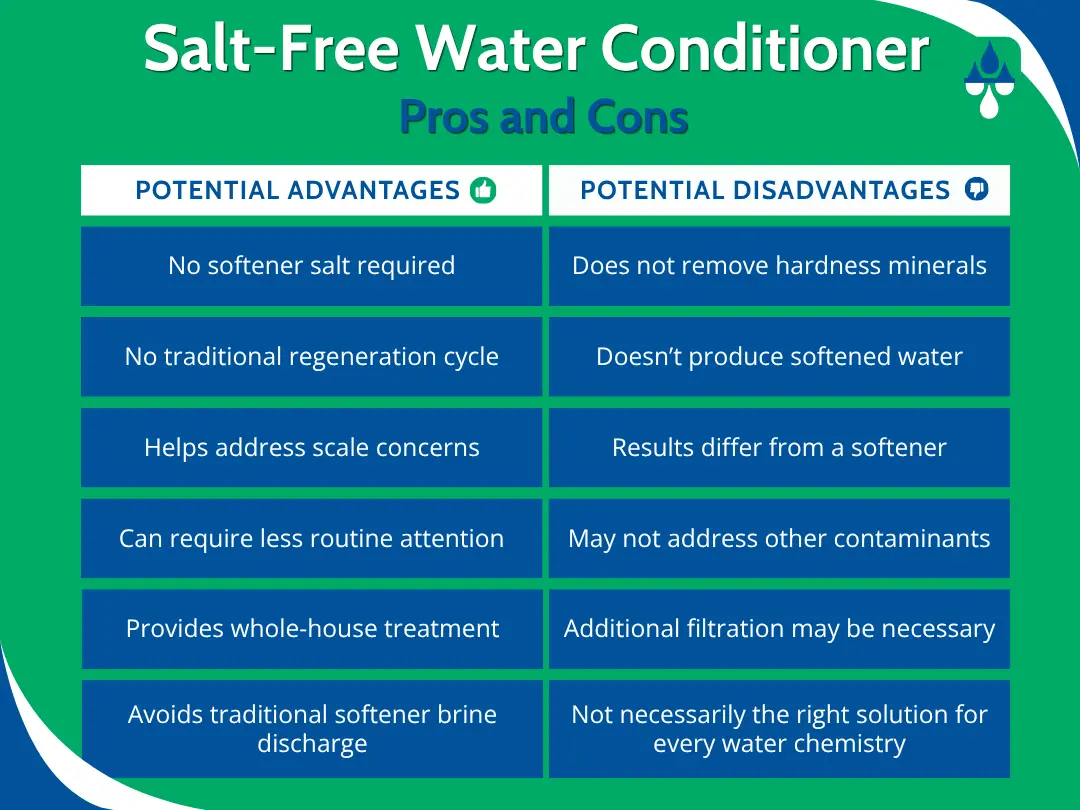
The question isn’t whether one column outweighs the other. It’s whether the benefits of salt-free conditioners match your priorities.
Salt-Free Conditioner vs. Water Softener: Which One Is the Better Investment?
Think about what you want your water treatment system to accomplish.
Consider a salt-free water conditioner if you:
- Primarily want help controlling scale.
- Don’t want to regularly purchase or add salt.
- Want to avoid a traditional softener regeneration cycle.
- Prefer a relatively low-maintenance approach.
- Don’t necessarily need hardness minerals removed from your water.
Consider a traditional water softener if you:
- Specifically want calcium and magnesium hardness minerals removed.
- Want truly softened water.
- Have significant hardness and want the benefits associated with traditional ion-exchange softening.
- Don’t mind adding salt and maintaining a conventional softening system.
And if drinking water quality is your primary concern, you may want to consider reverse osmosis or another filtration system, either on its own or alongside whole-house treatment.
What Is the Best Salt-Free Water Conditioner?
Searching for the best salt-free water conditioner can produce plenty of products claiming to be the answer. In reality, “best” depends heavily on your home’s water conditions and your goals.
Before choosing a system, consider:
- Your home’s water hardness
- The source of your water
- Your household’s water usage
- Other water quality concerns
- The system’s capacity and treatment technology
- Installation requirements
- Maintenance requirements
- Manufacturer support and warranty
- Whether you need additional filtration
Most importantly, be wary of choosing a system solely because of an impressive list of marketing claims.
The best water treatment system isn’t necessarily the one that promises to do the most. It’s the one designed to address the specific problems present in your water.
Should You Test Your Water Before Buying a Conditioner?
Yes. This is one of the smartest things you can do before investing in any water treatment equipment.
Without understanding your water, you could purchase a conditioner when you really need a softener—or install a softener when a different combination of treatment technologies would better accomplish your goals.
Testing gives you a factual starting point.
At Rayne of the Wine Country, we can evaluate your water and discuss the advantages and limitations of different treatment options based on your household’s actual needs.
The goal isn’t simply to install a particular type of equipment. It’s to determine which solution makes sense for your water.
Learn more: What Do Your Water Test Results Really Mean?
FAQs About Salt-Free Water Conditioners
Are salt-free water conditioners worth it?
They can be a worthwhile investment for homeowners who want scale control without the salt, regeneration, and brine discharge associated with traditional water softeners. However, they aren’t a direct substitute for a water softener if your goal is to physically remove hardness minerals.
Do salt-free water conditioners actually work?
Yes, when they’re used for their intended purpose and properly matched to the home’s water conditions. Salt-free conditioners are generally designed to change the behavior of hardness minerals to help reduce scale formation rather than remove calcium and magnesium from the water.
Does a salt-free conditioner make water soft?
No. Technically, a salt-free conditioner does not soften water because it doesn’t remove the calcium and magnesium responsible for water hardness. It conditions the water to help address scale instead.
Will a salt-free conditioner remove chlorine?
Don’t assume that every salt-free conditioner removes chlorine. Chlorine reduction requires appropriate filtration media. Some whole-house systems may combine conditioning and filtration technologies, so it’s important to understand exactly what a particular system is designed to treat.
Is a salt-free conditioner better than a water softener?
Neither is universally better. They’re different technologies designed to achieve different results. A conditioner may be preferable for homeowners focused on scale control and salt-free operation, while a traditional softener is generally better for homeowners who specifically want hardness minerals removed.
Do salt-free water conditioners require maintenance?
Yes, although maintenance can be different from conventional softeners and varies by system. They don’t require routine additions of softener salt or traditional regeneration, but treatment media, filters, or other components may eventually require service or replacement.
Can I use a salt-free conditioner and reverse osmosis system together?
Yes. The systems perform different jobs. A whole-house conditioning system can address scale concerns throughout the home, while a reverse osmosis system can provide highly filtered water at a designated drinking water faucet.
How do I know which water treatment system I need?
Start with your water rather than the equipment. Testing your water and identifying the problems you actually want to solve makes it much easier to determine whether you need a salt-free conditioner, traditional softener, filtration system, reverse osmosis system, or a combination of technologies.
So, Are Salt-Free Water Conditioners Worth the Money?
For the right homeowner, absolutely! But they’re worth the investment when they’re purchased for the right reasons.
If you want to reduce scale, avoid adding salt, eliminate traditional softener regeneration, and simplify ongoing ownership, a salt-free water conditioning system may be an excellent fit.
If your priority is removing hardness minerals and achieving truly softened water, a traditional softener will probably make more sense. And if your concerns involve drinking water, chlorine, taste, odor, or other water quality issues, additional or entirely different treatment may be appropriate.
That’s why the best place to begin isn’t by asking, “Which system should I buy?” It’s by asking, “What’s in my water, and what do I want to change about it?”
Find the Right Water Treatment Solution for Your Wine Country Home
You don’t have to guess.
At Rayne of the Wine Country, we can help you understand your home’s water quality and compare treatment options based on what you actually need. Whether the right solution is a salt-free water conditioner, traditional water softener, whole-house filtration system, reverse osmosis drinking water system, or a combination of treatments, we’ll help you make an informed decision.
Schedule your free water test with us today and find out which water treatment solution makes the most sense for your home.