If you’re researching ways to improve the water in your Wine Country home, you’ve probably come across two popular options: water softeners and salt-free water conditioners.
At first glance, they may seem like two different ways of accomplishing the same thing. Both can help address problems associated with hard water and mineral scale, and both can improve your experience with the water throughout your home. But they work very differently—and choosing the right system depends on your water quality, household needs, and what you want your water treatment system to accomplish.
So, when comparing a salt-free water conditioner vs. water softener, which one should you choose?
The answer isn’t necessarily that one technology is better than the other. It’s about choosing the technology that’s best suited to your home’s water.
Let’s compare how water softeners and salt-free water conditioners work, what problems they address, their maintenance requirements, and the types of households that may benefit from each.
Salt-Free Water Conditioner vs. Water Softener: What’s the Main Difference?
The most important distinction is simple:
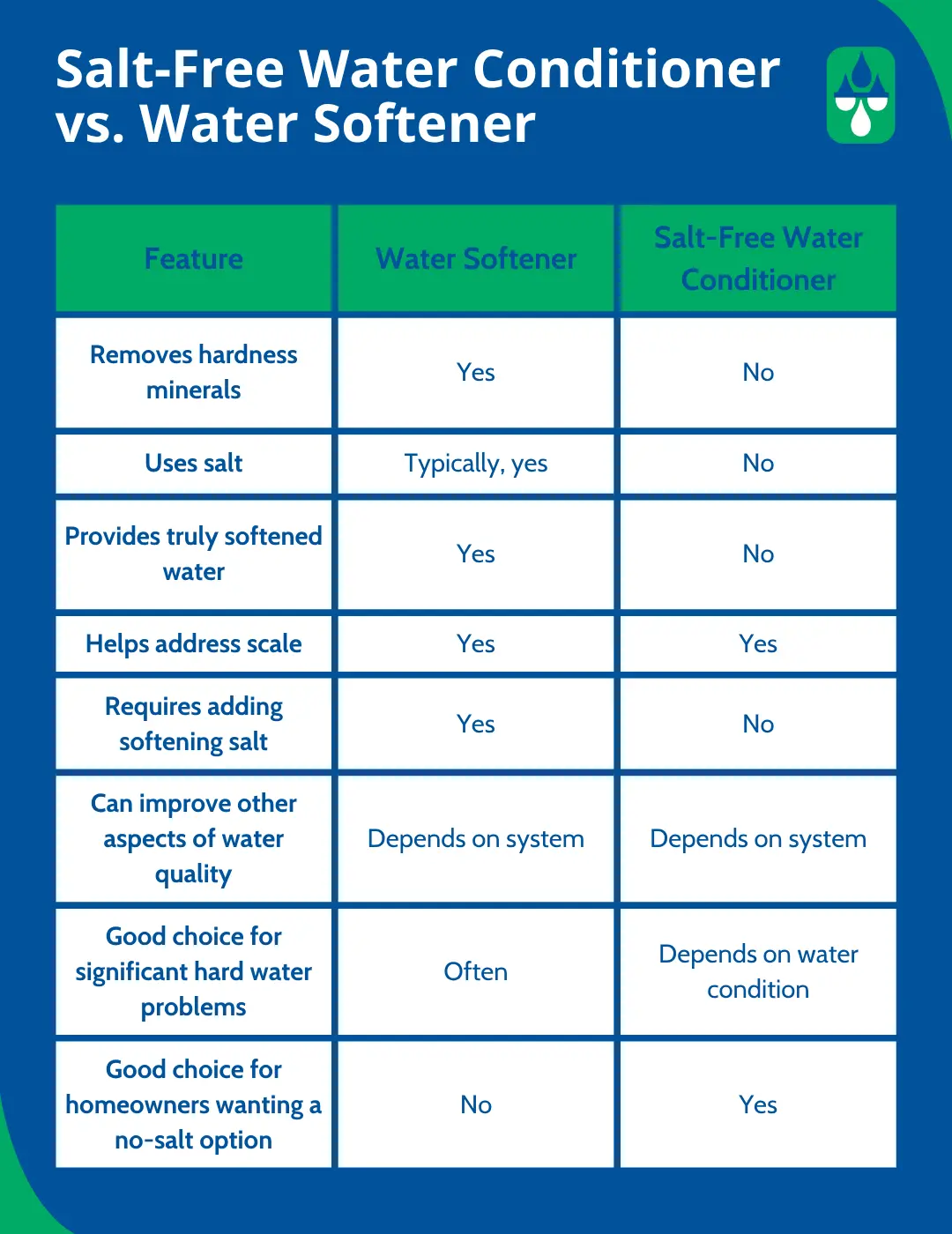
A water softener actually softens hard water by removing hardness minerals such as calcium and magnesium. A salt-free water conditioner does not remove those minerals in the same way. Instead, it conditions the water to help protect against scale and corrosion while offering additional water quality benefits depending on the system.
That distinction matters because homeowners sometimes assume that a salt-free conditioner is simply a traditional water softener that operates without salt. That’s not quite accurate.
Both can be valuable whole-home water treatment solutions, but they solve water problems differently.
Quick Comparison: Salt-Free Water Conditioner vs. Water Softener
Understanding these differences makes it much easier to narrow down your options.
How Does a Traditional Water Softener Work?
Traditional water softeners are specifically designed to treat hard water.
Hard water contains dissolved minerals, primarily calcium and magnesium. Although these naturally occurring minerals aren’t generally the type of contaminants homeowners associate with unsafe drinking water, they can create frustrating problems throughout a home.
Hard water can contribute to:
- White, crusty scale around faucets and fixtures
- Mineral buildup inside plumbing
- Spots and film on glasses and dishes
- Soap scum in tubs and showers
- Reduced soap and detergent effectiveness
- Stiff or dingy laundry
- Dry-feeling skin and hair
- Scale inside water-using appliances
- Reduced appliance efficiency
Learn more: Spotting the Signs of Hard Water: What Every California Homeowner Needs to Know
A traditional water softener addresses the source of these problems by removing hardness minerals through a process known as ion exchange.
As water passes through the softener’s resin, calcium and magnesium ions are captured and exchanged for sodium or potassium ions. The result is genuinely softened water flowing throughout the home.
What Does a Water Softener Do Best?
If your primary objective is to eliminate the effects of hard water, a traditional softener can be an excellent solution.
Because it removes calcium and magnesium, softened water can help reduce scale accumulation and make a noticeable difference in everyday activities such as bathing, washing dishes, doing laundry, and cleaning.
Homeowners often appreciate benefits such as:
- Less mineral scale on faucets and fixtures
- Reduced soap scum
- Better soap and shampoo lather
- Fewer hard water spots
- Softer-feeling laundry
- Protection for plumbing and water-using appliances
- Easier household cleaning
For homes with significant hardness, removing the hardness minerals themselves may provide the results the homeowner wants.
What Doesn’t a Water Softener Do?
It’s equally important to understand what a water softener isn’t designed to do.
A standard water softener should not automatically be considered a comprehensive water filtration system.
Its primary purpose is hardness removal. Other water quality concerns may require additional treatment.
For example, depending on what’s present in your water, you might need another treatment system to address concerns involving drinking water quality, taste and odor, chlorine, total dissolved solids (TDS), or specific contaminants.
That’s why choosing a water treatment system based solely on the fact that you “don’t like your water” isn’t enough. You need to know what’s actually in it and what you want to change.
How Does a Salt-Free Water Conditioner Work?
A salt-free water conditioner, sometimes called a no-salt water conditioner, takes a different approach.
Rather than using traditional ion exchange to remove calcium and magnesium from the water, a salt-free system is designed to provide scale protection without requiring homeowners to continually purchase and add water-softening salt.
In other words, the hardness minerals aren’t being removed in the same way they are with a traditional softener.
This is why “water conditioner” is an important distinction: conditioned water and softened water aren’t technically the same thing.
For the right household, however, a no-salt conditioner can offer an attractive alternative.
What Are the Benefits of a Salt-Free Water Conditioner?
For homeowners interested in water softener alternatives, eliminating the need for softening salt can be one of the biggest advantages.
Depending on the specific system, benefits can include:
- Scale and corrosion protection
- No bags of water-softening salt to purchase
- No heavy salt bags to carry and store
- Reduced maintenance compared with traditional salt-based systems
- Improved water taste and odor
- Reduction of chlorine and certain other water-quality concerns
- Whole-home water treatment
- An environmentally conscious alternative to conventional softening
For example, at Rayne of the Wine Country, our salt-free conditioners are designed to provide scale and corrosion protection while also improving characteristics such as water taste, smell, color, and clarity.
For homeowners who don’t necessarily require traditional soft water but want to improve their overall water quality and protect their homes from scale, that combination can be compelling.
Learn more: Unpacking the Benefits of No-Salt Water Conditioners – California’s Eco-Friendly Choice
Does a Salt-Free Water Conditioner Actually Soften Water?
No—and this is one of the most important things to understand when comparing a salt-free water conditioner vs. water softener.
A traditional water softener removes calcium and magnesium hardness minerals through ion exchange.
A salt-free water conditioner doesn’t remove those hardness minerals in the same way. Instead, it treats or conditions the water to help minimize the problems those minerals can cause, particularly scale.
That means a no-salt conditioner should not be expected to produce exactly the same experience as traditionally softened water.
If your primary goal is to have truly soft water—with maximum reduction of hard water minerals—a traditional water softener may be a better fit.
If your priority is scale protection and improved water quality without purchasing or handling salt, a salt-free conditioner may be worth considering.
Which System Provides Better Scale Protection?
Both systems can address scale, but they do so differently.
A traditional water softener tackles scale at its source by removing the calcium and magnesium responsible for water hardness.
A salt-free conditioner provides scale protection without removing those minerals through conventional ion exchange.
Which approach makes the most sense depends on factors such as:
- Your home’s water hardness
- Other characteristics of your water
- Your plumbing and appliances
- Your household’s water consumption
- Expectations for how the treated water should feel and perform
- Your willingness to maintain a salt-based system
For homeowners experiencing severe hard water symptoms and wanting genuinely softened water, a conventional softener will often be the more appropriate option.
For households primarily interested in reducing scale-related problems while avoiding salt, a salt-free conditioner may be a better match.
Salt-Free Water Conditioner vs. Water Softener: How Do Maintenance Requirements Compare?
Maintenance is another important factor when choosing between the two technologies.
Water Softener Maintenance
Traditional automatic water softeners require salt or potassium for their ion exchange and regeneration process.
Depending on the equipment and your household’s water usage, ownership can involve:
- Checking salt levels
- Adding salt when necessary
- Occasionally cleaning the brine tank
- Checking the system for proper operation
- Periodic professional service
- Testing your water to verify performance
Modern high-efficiency water softeners can significantly improve salt and water efficiency compared with older equipment, but salt remains part of operating a conventional system.
Learn more: The Ultimate Guide to Water Softener Maintenance: How to Keep Your Softener Running Smoothly
Salt-Free Water Conditioner Maintenance
A no-salt conditioner eliminates one particularly noticeable maintenance task: buying and adding water-softening salt.
That can be attractive for homeowners who don’t want to repeatedly buy, transport, lift, store, and pour heavy bags of salt.
A salt-free system still isn’t completely maintenance-free. Treatment media, filters, or other components may eventually require inspection or replacement depending on the equipment and your home’s water conditions.
However, eliminating routine salt replenishment can make day-to-day ownership simpler.
What About Sodium in the Water?
This is another consideration that leads some homeowners to investigate salt-free water conditioners.
Traditional ion-exchange water softeners typically exchange calcium and magnesium for sodium or potassium. A salt-free conditioner doesn’t perform this conventional sodium-based ion exchange.
If minimizing added sodium is important to your household, that’s worth discussing with a water treatment professional.
It’s also important not to confuse water softening with drinking water purification. If you have specific concerns about sodium, TDS, or contaminants in your drinking water, a separate drinking water treatment technology such as reverse osmosis may be appropriate.
Again, the right solution depends on what’s actually present in your water.
Which Homes Are Good Candidates for a Water Softener?
A traditional water softener may be the better choice if:
- Your home has significant water hardness.
- You’re constantly cleaning mineral deposits from fixtures.
- Your glasses and dishes regularly come out spotted.
- Soap and shampoo don’t lather the way you’d like.
- You experience significant soap scum.
- You want genuinely softened water throughout your home.
- Protecting plumbing and water-using appliances from hardness is a major priority.
- You’re comfortable periodically replenishing salt.
For these households, the ability to actually remove calcium and magnesium can outweigh the maintenance associated with a traditional softener.
Which Homes Are Good Candidates for a Salt-Free Water Conditioner?
A salt-free water conditioner may make more sense if:
- You want scale protection without traditional salt-based softening.
- You don’t want to purchase, carry, store, or refill bags of salt.
- You’re interested in a low-maintenance water treatment solution.
- You want to improve certain taste, odor, chlorine, or other water-quality concerns along with scale protection, depending on the system.
- You prefer a water treatment approach that doesn’t rely on traditional ion-exchange softening.
- You understand that conditioned water isn’t the same as truly softened water.
Salt-free conditioning can also be particularly attractive in locations where conventional salt-based softening isn’t practical or where local regulations affect the use of certain water softeners.
Related article: Top 5 Benefits of Choosing a Salt-Free Water Conditioner for Your Home
What If You Have More Than One Water Quality Problem?
This is where choosing a water treatment system based on a website comparison alone can become difficult.
Your home may have hard water and another water quality concern at the same time.
For example, you might want to reduce scale throughout the house but also improve drinking water taste. Or you may have concerns about chlorine, TDS, or other substances.
One piece of equipment isn’t necessarily designed to solve every problem.

Depending on your water test results, your best solution could involve a combination of technologies, such as:
- A traditional water softener
- A salt-free water conditioner
- Whole-home filtration
- Chlorine removal
- Reverse osmosis drinking water treatment
- Treatment specifically designed for well water
Rather than asking, “What’s the best water treatment system?” a better question is:
“What’s the best water treatment system for the water in my home?”
Water Softener vs. Salt-Free Conditioner: How Do You Decide?
If you’re deciding between the two, start by identifying your priorities.
Consider a traditional water softener when:
Your biggest concern is hard water itself and you want to remove the calcium and magnesium responsible for it.
Consider a salt-free conditioner when:
Your priorities include scale protection, certain water quality improvements, and avoiding the use of water-softening salt.
But don’t make your decision based on preferences alone.
Two homes a few miles apart can have different water conditions. Municipal water and private well water can present different challenges, and factors such as hardness and TDS can vary.
The best way to make an informed purchase is to test first and treat second.
Related article: Are Salt-Free Water Conditioners Worth It? What Homeowners Should Know Before Buying
What’s the Best Water Treatment Solution for Your Wine Country Home?
There isn’t a universal winner in the salt-free water conditioner vs. water softener debate.
The key is matching the equipment to your home’s actual water conditions.
At Rayne of the Wine Country, we help homeowners throughout California’s Wine Country find water treatment solutions based on their individual needs. Whether a traditional water softener, no-salt water conditioner, drinking water system, or combination of technologies makes the most sense, the process should start with understanding your water.
Don’t Guess—Start With a FREE Water Test
Before investing in a water treatment system, schedule a FREE water test with us.
We’ll help identify your water’s characteristics, discuss the issues you’re experiencing and explain which treatment options are best suited to your household. Then, you can confidently choose a system based on your actual water—not assumptions.