
California homeowners have plenty to think about when it comes to their water. Hard water minerals can contribute to scale buildup, municipal disinfectants such as chlorine can affect taste and odor, and many homeowners want an effective whole-home solution without the salt and maintenance associated with a traditional water softener.
For some households, a salt-free water conditioner offers an appealing alternative.
Rather than removing hardness minerals through traditional ion exchange, a salt-free system conditions water to help control the effects of mineral scale. Depending on the system, it may also incorporate filtration designed to address chlorine and other water-quality concerns.
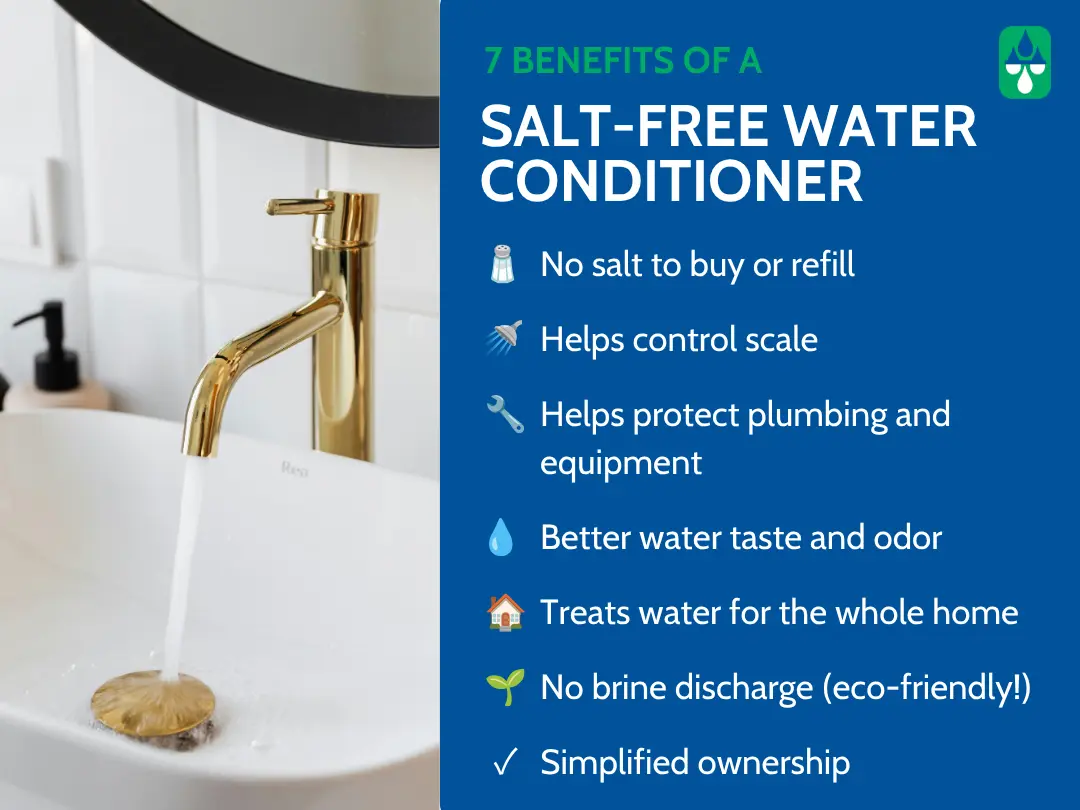
7 Key Benefits of Salt-Free Water Conditioners That California Homeowners Should Consider
So, what are the most important salt-free water conditioner benefits, and is this type of system right for your California home?
Let’s take a closer look.
1. There’s No Salt to Buy, Haul, or Refill
One of the most noticeable benefits of salt-free water treatment is right in the name: there’s no salt to add to the system.
Traditional water softeners typically use an ion-exchange process that requires salt or potassium to regenerate the system. That means homeowners periodically need to purchase bags of salt, transport them home, and refill the brine tank.
A salt-free water conditioner eliminates that routine.
For homeowners who would prefer not to lift heavy salt bags, store extra bags in the garage, or keep track of salt levels, this can make owning a water treatment system significantly more convenient.
It can be especially appealing for people looking for a more hands-off salt-free water system for home use.
Wondering how a salt-free system can condition water without salt? Read our guide, What Is a Salt-Free Water Conditioner and How Does It Work?, for a closer look at the technology.
2. Salt-Free Water Conditioners Help Protect Against Scale Buildup
Hard water contains naturally occurring minerals, primarily calcium and magnesium. As water travels through your plumbing and is heated by appliances such as your water heater, those minerals can contribute to scale deposits.
Over time, scale can accumulate in places you don’t necessarily see, including plumbing, water heaters and other water-using appliances.
One of the primary salt-free water conditioner benefits is scale control.
Unlike a traditional water softener, a salt-free conditioner does not actually remove calcium and magnesium from your water. Instead, the conditioning process changes how hardness minerals behave, helping reduce their tendency to adhere to surfaces and form scale.
That distinction is important. If your goal is to actually remove hardness minerals and create traditionally “soft” water, a water softener may be the better option. On the other hand, if you’re primarily concerned about controlling scale without salt, a salt-free conditioner may be an excellent fit.
3. Salt-Free Water Treatment Can Help Protect Plumbing and Water-Using Equipment
Scale isn’t just a cosmetic issue. Mineral accumulation inside a home’s plumbing and water-using equipment can become a long-term concern.
Reducing scale formation can help protect components throughout the home, including:
- Water heaters
- Faucets and fixtures
- Showerheads
- Pipes
- Dishwashers
- Washing machines
- Other water-using appliances
Controlling scale can therefore be an important part of protecting the systems and equipment that use water every day.
Some salt-free treatment systems can also help address other water characteristics that may contribute to plumbing concerns. The exact benefits depend on the treatment technology and the chemistry of your home’s water, which is why professional water testing and system selection are important.
4. Chlorine Reduction Can Improve Taste and Odor
Not every benefit of a salt-free water treatment system has to do with water hardness.
Depending on the specific system and filtration media included, a whole-home salt-free system may also help reduce chlorine and improve water’s taste and odor.
Municipal water treatment commonly uses disinfectants to keep water safe as it moves through the distribution system. By the time that water reaches your home, however, you may not enjoy the chlorine taste or smell that remains.
A properly selected whole-home treatment system can reduce chlorine before the water reaches your faucets and showers.
That means better-tasting, better-smelling water isn’t limited to a single drinking water faucet. You’re improving the water you use throughout the home.
Keep in mind that treatment capabilities vary by system. A professional water test can help determine what’s in your water and which treatment technology is appropriate for the issues you want to address.
5. A Salt-Free Water Conditioner Benefits Water Throughout Your Home
Another advantage of choosing a salt-free water system for home use is that these systems can provide whole-home treatment.
Point-of-use filtration, such as a reverse osmosis drinking water system, is excellent when your primary concern is the water you drink and use for cooking. But that doesn’t address water flowing to your showers, laundry room, water heater, dishwasher and other fixtures.
A whole-home salt-free conditioner treats water as it enters your house.
That makes conditioned water available throughout the home and can help address scale concerns anywhere water is being used.
For homeowners with multiple water quality goals, a whole-home conditioner can also be paired with other treatment technologies. For example, you might use whole-home treatment for scale and chlorine concerns while relying on reverse osmosis for highly filtered drinking and cooking water.
The right combination depends on your home’s water chemistry and your priorities.
6. Salt-Free Conditioning Offers Environmental and Water-Use Advantages
For homeowners who want to consider resource use when choosing a water treatment system, salt-free conditioning offers some noteworthy advantages.
Traditional ion-exchange softeners periodically go through a regeneration cycle. That process uses water and creates a wastewater discharge containing chloride from the salt used during regeneration.
Salt-free conditioners work differently. Because they don’t regenerate with salt in the same manner as conventional softeners, they eliminate the need for salt-based regeneration.
That means:
- No softener salt consumption
- No salt bags or related packaging
- No brine discharge from softener regeneration
- No water used for conventional regeneration cycles
For California homeowners who are conscious of water use and want to minimize the ongoing resources required for home water treatment, these can be meaningful considerations.
It’s important, however, to choose a system based on performance as well as environmental preferences. A salt-free conditioner and a traditional water softener do different things, so one isn’t automatically a substitute for the other.
Our guide to Salt-Free Water Conditioner vs. Water Softener: Which Is Right for Your Wine Country Home? explains those differences in greater detail.
7. Simplified Day-to-Day Ownership
For many homeowners, one of the biggest benefits of salt-free water treatment is simply convenience.
There’s no brine tank to keep filled and no recurring salt purchases. Depending on the system installed, routine maintenance may primarily involve periodic filter or media replacement rather than ongoing salt management and regeneration.
That can make a salt-free conditioner particularly attractive to homeowners who want whole-home water treatment without adding another complicated household chore to their schedule.
Professional installation also helps ensure the system is appropriately sized and configured for your household’s water conditions and usage.
Once installed, you can enjoy the benefits of conditioned water throughout the house without constantly thinking about your water treatment equipment.
Is a Salt-Free Water Conditioner the Same as a Water Softener?
No, and this is one of the most important things to understand before choosing a system.
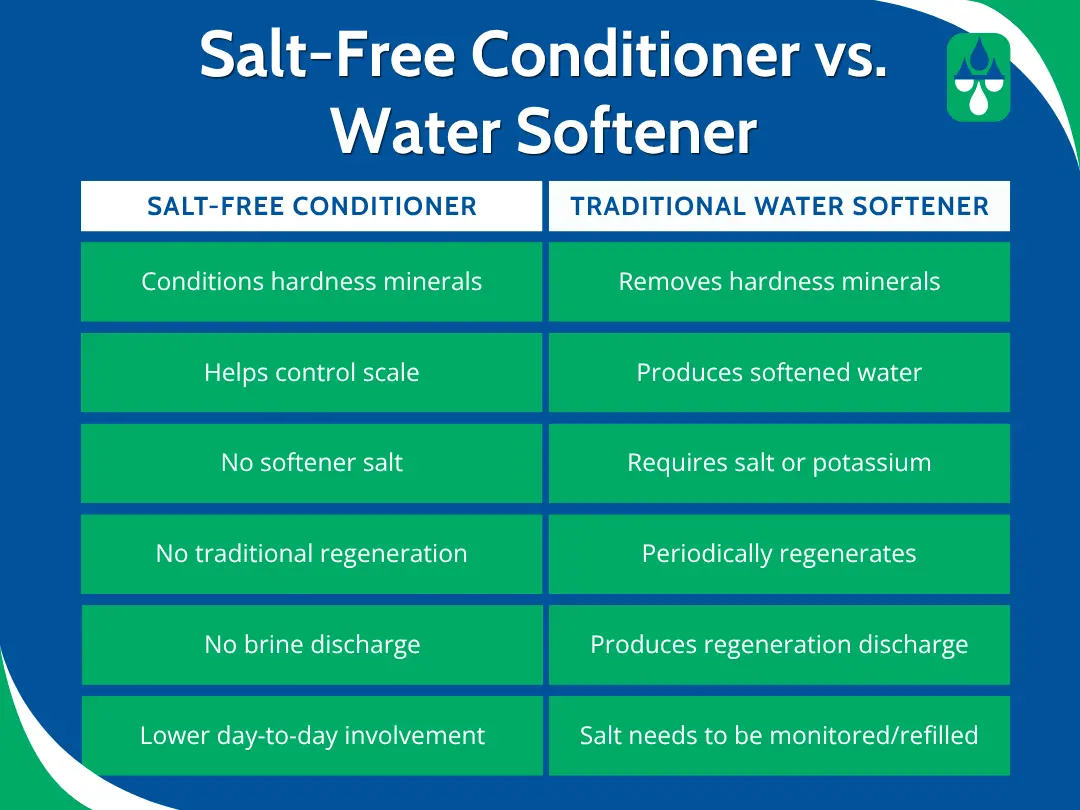
A conventional water softener typically uses ion exchange to remove calcium and magnesium hardness minerals from the water and replace them with sodium or potassium ions.
A salt-free conditioner generally does not remove those hardness minerals. Instead, it treats them in a way designed to reduce their ability to form scale.
As a result, a salt-free conditioner may be an excellent choice if your primary goals include scale control, eliminating salt use and simplifying maintenance. But if you want truly softened water and maximum hardness mineral removal, a traditional water softener may be more appropriate.
Neither technology is automatically better for every homeowner.
The better question is: Which system solves the specific water problems in your home?
That’s where water testing can help.
Who Is a Good Candidate for a Salt-Free Water System?
A salt-free conditioner may be worth considering if you:
- Want to reduce scale without using salt
- Don’t want to purchase or carry bags of softener salt
- Want a low-maintenance whole-home solution
- Are concerned about water use associated with softener regeneration
- Want to avoid brine discharge
- Want whole-home chlorine reduction when paired with appropriate filtration
- Prefer to leave calcium and magnesium in your water rather than remove them
On the other hand, households dealing with significant hardness that specifically want the characteristics of truly softened water may be better candidates for a conventional water softener.
Water quality also varies from one home and community to another. That’s why selecting water treatment equipment based solely on a general description of the technology isn’t ideal.
Testing your water first gives you a much clearer picture of what you’re actually trying to treat.
FAQs About Salt-Free Water Conditioner Benefits
Does a salt-free water conditioner remove chlorine?
Some salt-free water treatment systems incorporate filtration media designed to reduce chlorine, but not every conditioner has the same capabilities. Ask your water treatment professional what contaminants or water quality issues a particular system is designed to address.
Will a salt-free conditioner help with hard water scale?
Scale control is one of the primary reasons homeowners choose salt-free water conditioning. Rather than removing hardness minerals, the conditioning process helps reduce their tendency to adhere to surfaces and form scale.
Do salt-free water conditioners require electricity?
Requirements vary depending on the system and technology. Some salt-free conditioning systems can operate without the regeneration equipment required by conventional water softeners. Your water treatment professional can explain the operating requirements of the specific system recommended for your home.
Is a salt-free water conditioner maintenance-free?
No water treatment system should automatically be considered maintenance-free. Salt-free conditioners eliminate routine salt refills and conventional softener regeneration, but filters or treatment media may eventually require replacement or service. Maintenance requirements vary by system.
Can I use a salt-free conditioner with other water treatment systems?
Yes. Whole-home conditioning can be combined with other treatment technologies when appropriate. For example, homeowners may pair a whole-home salt-free conditioner with a reverse osmosis system that provides additional filtration specifically for drinking and cooking water.
How do I know whether I need a salt-free conditioner or water softener?
Start by determining your water’s hardness and identifying any additional water quality concerns. Then, consider what you want the system to accomplish. If you want hardness minerals removed, a traditional softener may be appropriate. If scale control without salt is the priority, a salt-free conditioner may be a better fit.
Discover the Benefits of Salt-Free Water Treatment With Rayne of the Wine Country
The right water treatment system should match your water, your household and your priorities.
At Rayne of the Wine Country, we offer salt-free water conditioners designed to give homeowners an alternative to traditional salt-based water softening.
For the right household, the advantages can be substantial: no salt bags to buy or carry, scale protection, whole-home treatment, chlorine reduction, improved taste and odor, fewer concerns about regeneration and simpler day-to-day ownership.
But you don’t have to guess which type of water treatment is right for your home.
Contact us today to schedule a free water test. We’ll evaluate your home’s water and help you determine whether a salt-free water conditioner, traditional water softener or another water treatment solution is the best match for the water quality concerns you want to address.