A water softener is supposed to make everyday life easier. From cleaner dishes and softer laundry to less mineral buildup on plumbing fixtures, a properly functioning system helps protect your home from the effects of hard water.
But what happens when your water softener stops doing its job?
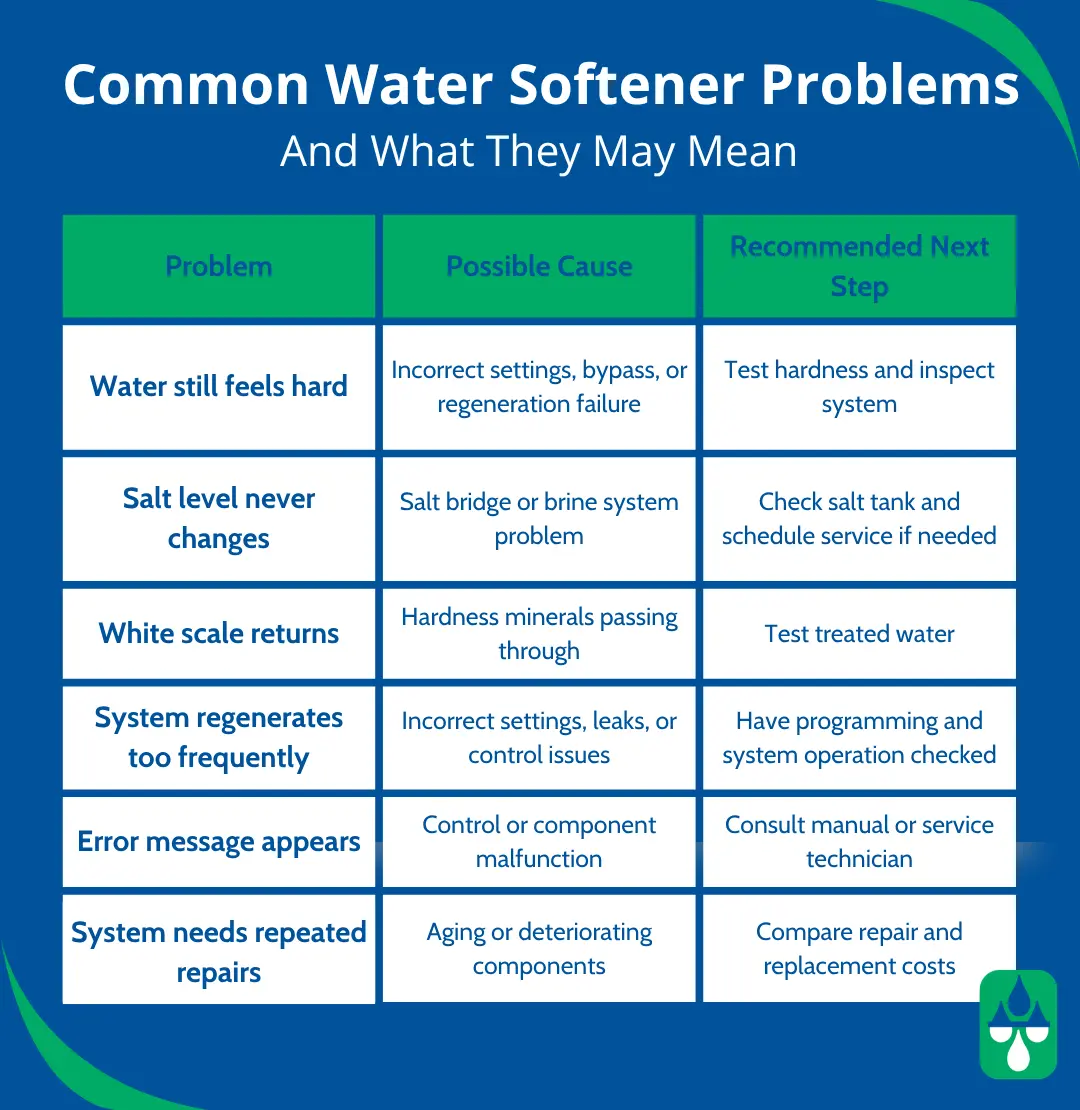
The signs aren’t always obvious. Your system might still be running, the salt tank may look normal, and water may continue flowing through your home—even when the softener isn’t removing hardness minerals effectively.
If you’re wondering how to tell if your water softener is working, there are several warning signs you can look for before a small problem becomes a bigger one.
Below, we’ll cover seven common signs that your water softener may need attention, how to test its performance, and when to consider professional maintenance, repairs, or an upgrade.
How Do You Know If Your Water Softener Is Working?
The most reliable way to tell if your water softener is working is to test the hardness of the water coming out of the system and compare it with your untreated water.
A properly operating conventional ion-exchange water softener should significantly reduce calcium and magnesium hardness.
You may also notice everyday signs that your system is working properly, including:
- Soap and shampoo lather more easily.
- Dishes and glassware have fewer hard water spots.
- Faucets and showerheads develop less mineral scale.
- Laundry feels cleaner, with less mineral-related stiffness.
- The system regenerates and uses salt as expected.
- Water hardness tests show that the treated water is soft.
If these benefits begin to disappear, your water softener may not be performing as well as it should.
7 Warning Signs Your Water Softener Isn’t Working Properly
1. Soap and Shampoo Don’t Lather Like They Used To
Have you noticed that you need more soap to wash your hands or more shampoo to get a good lather?
Hard water contains dissolved calcium and magnesium, which react with soap and reduce its cleaning effectiveness. When your water softener is working properly, soap generally lathers more easily because these hardness minerals have been removed.
Warning signs to watch for:
- You need more soap or shampoo than usual.
- Body wash doesn’t create as much lather.
- Soap leaves a film on your skin or shower surfaces.
- Cleaning products seem less effective.
Keep in mind that different soaps and detergents behave differently. Poor lather alone doesn’t prove your softener is malfunctioning, but a noticeable change can be an early clue.
What to do: Check your system’s salt level and settings. Then, consider testing your water hardness to see whether the softener is still removing minerals effectively.
2. White Scale and Mineral Buildup Are Returning
One of the biggest benefits of a water softener is reducing the mineral scale that hard water leaves behind.
If you begin noticing white, chalky deposits around faucets, showerheads, sinks, or other fixtures, your system may not be softening your water effectively.
Common signs include:
- White crust around faucets and showerheads
- Mineral deposits on sink fixtures
- More frequent hard water spots on shower doors
- Scale buildup in kettles or other water-heating appliances
Hard water scale can also accumulate inside plumbing and water-using appliances, potentially reducing their efficiency over time.
What to do: Clean existing deposits and watch whether they return. Because older scale doesn’t disappear immediately when water is softened, new buildup is a more useful warning sign than deposits that were already present.
If scale keeps returning, professional water hardness testing can help determine whether your softener needs maintenance or repairs.
3. Your Water Softener Isn’t Using Salt Normally
For conventional salt-based water softeners, salt plays an essential role in the regeneration process.
During regeneration, the system uses a brine solution to restore the resin’s ability to remove hardness minerals from your water.
If your salt level never seems to change—or you’re suddenly using much more salt than usual—there may be a problem.
Potential warning signs include:
- Salt levels remain unchanged for an unusually long time.
- The system appears to be regenerating but isn’t softening water.
- A hard salt bridge forms inside the brine tank.
- Salt consumption increases unexpectedly.
- The brine tank contains an unusual amount of standing water.
A salt bridge is a hardened crust that can form above the water in the brine tank, preventing the system from dissolving the salt it needs for regeneration.
However, salt consumption naturally varies based on water hardness, household water use, system settings, and regeneration frequency.
What to do: Check the salt level and look for signs of bridging. Follow your manufacturer’s instructions for safely addressing salt-related problems.
If the salt level is normal but the system isn’t softening water, a service technician can inspect the regeneration cycle, brine components, and control settings.
4. Your Dishes and Glassware Have More Water Spots
If your dishwasher suddenly seems less effective, the problem may not be the appliance itself.
Hard water minerals can leave cloudy spots and residue on dishes, glassware, and silverware after washing.
You might notice:
- More white spots on drinking glasses
- Cloudy-looking glassware
- Mineral residue on silverware
- Increased spotting on kitchen fixtures
These changes may indicate that your water softener isn’t removing enough hardness minerals.
Of course, water spots can also result from dishwasher settings, detergent, rinse aid, or other dissolved substances in the water.
What to do: Check your dishwasher settings and cleaning products. Then, test your softened water. If hardness levels are higher than expected, the softener may need attention.
5. Your Laundry Feels Stiff, Dingy, or Doesn’t Wash as Well
Have your towels become scratchier? Do your clothes feel stiff even after washing?
Hard water can interfere with the performance of some laundry detergents and contribute to mineral residue on fabrics.
If your water softener stops working properly, you may notice:
- Towels that feel rough or stiff
- Clothes that don’t seem as clean
- Increased detergent use
- Mineral-related residue on fabrics
- Whites that appear dull over time
These changes can develop gradually, making them easy to overlook.
What to do: If your laundry routine hasn’t changed but the results have, check whether your water softener is still functioning properly. A hardness test can help you determine whether untreated hard water is reaching your washing machine.
6. Your Water Softener Isn’t Regenerating Correctly
Most conventional water softeners periodically go through a regeneration cycle to maintain their ability to remove hardness minerals.
Depending on the system, regeneration may occur on a timer or in response to the amount of water your household uses.
If the regeneration process isn’t happening correctly, the softener can gradually lose its effectiveness.
Signs of a possible regeneration problem include:
- Error messages on the control panel
- Incorrect time or programming settings
- Unusual noises during regeneration
- A system that seems stuck in one cycle
- Unexpectedly frequent regeneration
- Hard water returning even though the salt tank is full
Power interruptions, control valve problems, clogged components, or incorrect settings can sometimes interfere with normal regeneration.
What to do: Check your owner’s manual for error messages and recommended troubleshooting steps. Make sure the system has power, the time is correct, and the bypass valve is in the proper operating position.
If the problem continues, schedule professional service rather than repeatedly forcing regeneration cycles without identifying the underlying issue.
7. Your Water Tests Hard Even After Passing Through the Softener
This is one of the clearest indications that your water softener may not be working properly.
A conventional water softener is designed to remove calcium and magnesium hardness minerals through ion exchange.
If the water leaving the system still tests hard, something may be wrong with the equipment, its settings, or the treatment process.
Possible causes include:
- Insufficient salt or an ineffective regeneration cycle
- Incorrect hardness settings
- A malfunctioning control valve
- Worn or fouled resin
- A bypass valve left open
- A system that is undersized for household demand
- Changes in incoming water hardness
What to do: Test both your untreated water and your softened water. If your treated water consistently shows significant hardness, contact a water treatment professional for a thorough system evaluation.
At Rayne of the Wine Country, professional water testing and system evaluation can help homeowners identify water hardness problems and determine whether water softener maintenance, repairs, or replacement are the best next step.
How Often Should You Service Your Water Softener?
Regular maintenance helps your water softener operate efficiently and may extend its useful lifespan.
The ideal maintenance schedule depends on the type of system, water quality, household demand, and manufacturer recommendations.
For many homeowners, a professional inspection approximately once a year is a reasonable starting point, although some systems need more or less frequent service.
Routine water softener maintenance may include:
- Checking salt levels and brine tank condition
- Testing incoming and treated water hardness
- Inspecting the control valve and regeneration settings
- Checking for leaks or blocked components
- Cleaning or servicing the brine system as needed
- Evaluating resin performance
- Confirming the system is operating efficiently
Preventive maintenance can often catch minor issues before they become expensive repairs.
If you haven’t had your water softener inspected in several years, scheduling a professional evaluation may be worthwhile—especially if you’re beginning to notice hard water symptoms.
When Should You Repair vs. Replace Your Water Softener?
Not every water softener problem means you need a new system.
A relatively simple issue, such as incorrect programming, a salt bridge, or a replaceable component, may be resolved with professional maintenance or repairs.
However, there are situations where upgrading to a newer system may make better financial and practical sense.
Consider Repairing Your Water Softener If:
- The system is relatively new and otherwise in good condition.
- The problem involves a serviceable component.
- Repair costs are reasonable compared to replacement.
- The softener is properly sized for your home.
- The system has generally been reliable.
Consider Replacing Your Water Softener If:
1. Your system is getting old.
Many conventional water softeners last approximately 10–15 years, although actual lifespan varies with water quality, equipment design, and maintenance.
If your system is approaching or exceeding that age and experiencing performance problems, it may be time to explore replacement options.
2. You’re paying for frequent repairs.
Occasional maintenance is normal. However, repeated service calls and expensive component replacements can make an aging system less economical to keep.
3. Your household’s water needs have changed.
A softener that worked well years ago may no longer be properly sized if your household has grown, your water consumption has increased, or your water conditions have changed.
4. Your current system uses more salt and water than necessary.
Some older timer-based systems regenerate on a fixed schedule regardless of how much softened water the household has used.
Modern demand-initiated systems can adjust regeneration based on water usage, potentially reducing unnecessary salt and regeneration water consumption.
Actual savings depend on the old and new systems, settings, incoming water hardness, and household demand.
5. You want a more environmentally conscious water treatment solution.
An appropriately sized, efficiently programmed water softener may help reduce salt consumption and regeneration wastewater compared with an inefficient older model.
Learn more: Should You Repair or Replace Your Water Softener: A Detailed Guide for Homeowners
For homeowners interested in other approaches, a salt-free water conditioner may also be worth discussing.
However, it’s important to understand that salt-free water conditioners generally do not remove hardness minerals the way conventional water softeners do. Instead, certain systems are designed to help manage scale formation.
Explore the pros and cons of each here: Salt-Free Water Conditioner vs. Water Softener: Which Is Right for Your Wine Country Home?
Can a New Water Softener Save Water and Salt?
Yes, depending on the efficiency and condition of your current system.
Newer water softeners may offer features such as:
- Demand-initiated regeneration: Regenerates based on actual water usage rather than a fixed timer.
- More precise control settings: Helps optimize salt and water consumption.
- Improved regeneration efficiency: May reduce unnecessary salt and water use.
- Better system sizing: Matches treatment capacity to your household’s needs.
- Modern monitoring features: Some systems provide alerts, usage information, or other helpful controls.
These improvements can make an upgrade especially appealing if you’re currently operating an outdated or inefficient water softener.
At Rayne of the Wine Country, homeowners can explore water treatment options that match their water hardness, household needs, and long-term maintenance preferences.
If you’re considering replacing an aging water softener but aren’t ready to purchase a new one, learn about the pros and cons of renting a system here: Renting vs. Buying a Water Softener: Which Makes Sense for Your Wine Country Home?
Frequently Asked Questions About Water Softener Performance
How can I tell if my water softener is working without a test kit?
Look for changes in soap lather, new mineral scale, cloudy glassware, stiff laundry, and unusual salt consumption. These signs can suggest a problem, but a hardness test is the best way to confirm whether your system is softening water.
Should softened water test at zero hardness?
A properly functioning conventional water softener often produces water with approximately 0–1 grains per gallon of hardness. Results may vary based on system design, settings, and operating conditions. If treated water consistently tests much harder than expected, the system may need service.
Why is my water softener full of salt but my water is still hard?
Possible causes include a salt bridge, a regeneration malfunction, incorrect settings, a brine system problem, or worn resin. A full salt tank doesn’t necessarily mean the system is regenerating properly.
How long does it take for a water softener to start working again?
Once a problem has been corrected and the system has completed a successful regeneration cycle, softened water may be available again. However, water already stored in your water heater or other parts of the plumbing may take longer to be replaced.
How long should a water softener last?
Many conventional water softeners last around 10–15 years, although some last longer with proper care. Water quality, usage, system design, and maintenance all influence lifespan.
Learn more: How Long a Water Softener Lasts: What Homeowners Need to Know
Is it better to repair or replace an old water softener?
It depends on the age of the equipment, repair costs, overall condition, and efficiency. Minor problems may be worth repairing, while an older system requiring frequent or costly service may be a better candidate for replacement.
Do water softeners need regular maintenance?
Yes. Conventional water softeners typically require periodic salt replenishment, monitoring, and occasional cleaning or professional servicing. Following the manufacturer’s recommendations can help maintain performance and reduce avoidable problems.
Can a water softener stop working even if it still runs?
Absolutely. A water softener can appear to operate normally while failing to remove hardness minerals because of regeneration issues, incorrect settings, resin problems, or other internal malfunctions. Testing treated water hardness is the most reliable way to identify this problem.
Keep Your Water Softener Working Properly With Rayne of the Wine Country
Your water softener plays an important role in protecting your plumbing, appliances, and everyday comfort from the effects of hard water.
If you’ve noticed returning mineral scale, poor soap lather, unusual salt consumption, or other warning signs, don’t wait until the problem becomes more expensive.
At Rayne of the Wine Country, we can help you evaluate your water treatment needs and determine whether your system needs maintenance, repairs, or an upgrade.
Whether your existing softener needs attention or you’re considering a newer, more efficient water treatment system, the goal is the same: reliable water quality and a solution that makes sense for your home.
Ready to find out if your water softener is working properly?
Contact us today to discuss your water softener concerns, ask about professional service, or explore water softener options for your Wine Country home.