
Hard water can be frustrating. You may see mineral deposits accumulating around faucets, scale on shower doors, spots on dishes, or buildup affecting water-using appliances. But what if you want to address some of these problems without installing a traditional salt-based water softener?
That’s where a salt-free water conditioner comes in.
Salt-free water conditioning systems provide an alternative approach to managing some of the effects of hard water. Instead of removing hardness minerals through traditional ion exchange, these systems condition the water to help prevent those minerals from forming stubborn scale.
For homeowners throughout Napa, Sonoma, Mendocino, Lake, and Solano Counties, that can be especially appealing when the goal is protecting plumbing and appliances from scale while avoiding bags of water-softening salt.
But how does a salt-free water conditioner work, exactly? Does it actually soften your water? Where do the hard water minerals go? And can the same system address chlorine?
Let’s take a closer look.
What Is a Salt-Free Water Conditioner?
A salt-free water conditioner, also called a no-salt water conditioner, is a water treatment system designed to reduce problems associated with mineral scale without using the traditional salt-based ion-exchange process.
Despite occasionally being described as a “salt-free water softener,” a salt-free conditioner isn’t technically a water softener.
A traditional water softener removes hardness minerals—primarily calcium and magnesium—from the water through ion exchange. A salt-free conditioner takes a different approach: the hardness minerals generally remain in the water, but the system changes how they behave so they are less likely to adhere to surfaces and form hard scale.
Think of the difference this way:
Water softening changes what’s in the water. Water conditioning changes how certain minerals in the water behave.
That distinction helps explain both the benefits and limitations of salt-free technology.
How Does a Salt-Free Water Conditioner Work?
The exact treatment process depends on the equipment and media being used, so not every salt-free system should be assumed to operate identically.
In general, however, the objective is to condition hardness minerals so they are less likely to attach to plumbing, heating elements, fixtures, and other surfaces as hard scale.
Instead of capturing calcium and magnesium and replacing them with sodium or potassium—as a traditional softener does—the conditioning media influences the way hardness minerals crystallize.
The minerals can then continue traveling with the water rather than accumulating as tenacious scale on surfaces.
This is why a salt-free system can provide scale protection even though a conventional hardness test may still detect calcium and magnesium in the water.
The system hasn’t removed the hardness minerals. It has conditioned them.
What Happens to Calcium and Magnesium?
This is one of the most important concepts for homeowners to understand.
When water is traditionally softened, calcium and magnesium ions are captured by the softener’s resin and exchanged for sodium or potassium ions.
With a no-salt water conditioner, calcium and magnesium generally remain in the water.
So where do they go?
They continue through the plumbing with the treated water. The purpose of conditioning is to make the minerals less likely to form hard deposits on surfaces.
That means you shouldn’t expect a hardness test performed after a salt-free conditioner to necessarily show “soft” water. The water can still technically be classified as hard because those dissolved minerals haven’t been removed.
What has changed is their tendency to create problematic scale.
Does a Salt-Free Conditioner Actually Soften Water?
No—not according to the technical definition of water softening.
Water hardness is largely determined by dissolved calcium and magnesium. To actually soften the water, those hardness minerals need to be removed or exchanged.
Traditional water softeners accomplish this using ion exchange.
A salt-free conditioner doesn’t perform conventional ion exchange, so it doesn’t produce “soft water” in the same way.
Why does that matter?
Because homeowners need realistic expectations about the experience they’ll get from a salt-free system.
With traditionally softened water, you may notice substantial changes in how soap lathers, how water feels on your skin, how much soap scum develops, and how much spotting you see on dishes and glass.
A salt-free conditioner shouldn’t automatically be expected to create all of those same results because calcium and magnesium are still present.
Its primary purpose is conditioning the water to provide protection against scale without traditional salt-based softening.
Does a Salt-Free Water Conditioner Help Prevent Scale?
Yes. Scale protection is one of the main reasons homeowners choose salt-free water conditioning.
Hard water scale forms when dissolved minerals—particularly calcium and magnesium—come out of solution and accumulate on surfaces.
You might recognize it as:
- White or chalky buildup around faucets
- Scale on showerheads
- Mineral deposits on fixtures
- Buildup inside pipes
- Scale on water-heating elements
- Deposits inside water-using appliances
A salt-free water conditioning system is designed to reduce the minerals’ ability to adhere to these surfaces as hard scale.
That can be valuable because scale isn’t merely a cosmetic problem. Mineral accumulation can affect fixtures, plumbing, water heaters, and other appliances that regularly come into contact with water.
Will a Salt-Free Conditioner Remove Existing Scale?
This is different from preventing new scale formation.
A salt-free conditioner should not be thought of as an instant “descaling” treatment that will immediately dissolve years of hardened mineral buildup throughout a home’s plumbing.
Its primary role is treating incoming water and helping reduce future scale formation.
Homeowners with significant existing scale may still need to clean fixtures, showerheads, or other accessible surfaces. Results within plumbing and appliances can depend on the existing condition of the system and the specific water chemistry involved.
This is another reason professional water testing and an evaluation of your home’s current water problems are useful before choosing treatment equipment.
Does a Salt-Free Water Conditioner Remove Chlorine?
It depends on the system.
Salt-free conditioning itself should not automatically be equated with chlorine filtration. Scale conditioning and chlorine reduction are different water-treatment functions.
However, some whole-house systems combine multiple treatment technologies or media, allowing one system to address scale while also reducing chlorine and improving characteristics such as taste and odor.
Rayne of the Wine Country’s no-salt conditioners, for example, are designed to provide scale and corrosion protection while also improving water taste, smell, color, and clarity and addressing chlorine.
This distinction is worth understanding when you’re comparing products.
Don’t assume every product marketed as “salt-free” automatically removes chlorine. Look at what the specific system is designed and certified or rated to treat.
Does a Salt-Free Conditioner Need to Regenerate?
Traditional automatic softeners periodically regenerate their resin. During regeneration, a concentrated brine solution is used to restore the resin’s ability to exchange hardness ions.
Because a salt-free conditioner doesn’t rely on traditional ion-exchange softening, it doesn’t require this same salt-based regeneration cycle.
That distinction contributes to one of the technology’s biggest practical benefits: simpler day-to-day ownership.
There is no brine tank to keep filled with softener salt simply to perform a conventional regeneration cycle.
What Maintenance Does a Salt-Free Water Conditioner Require?
“Salt-free” doesn’t mean “maintenance-free.”
While you won’t need to continually replenish softener salt, the system still contains treatment media and potentially filters or other components that eventually need attention.

Maintenance requirements vary according to:
- The specific salt-free system
- Type and quantity of treatment media
- Household water consumption
- Incoming water quality
- Water hardness
- Sediment or other substances in the water
- Manufacturer specifications
Depending on the system, maintenance may include periodic inspections, filter replacement, media replacement, or professional servicing.
The advantage is that routine ownership generally doesn’t involve monitoring and refilling a brine tank with water-softening salt.
When choosing a system, ask not only “How much does it cost?” but also “What will this system require from me over its lifetime?”
Understanding long-term maintenance can help you make a much more informed decision.
Will You Still See Water Spots With a No-Salt Conditioner?
You may.
Remember that calcium and magnesium remain in conditioned water. When water droplets evaporate from a surface, dissolved minerals can remain behind.
For that reason, a salt-free conditioner shouldn’t be expected to eliminate every visible spot in exactly the same way as removing hardness minerals through conventional softening.
This is an important difference between scale prevention and mineral removal.
The goal of salt-free conditioning is to help keep hardness minerals from forming stubborn scale deposits—not necessarily to make those minerals disappear.
Is Salt-Free Conditioned Water Safe to Drink?
Salt-free conditioning isn’t designed to make otherwise unsafe water safe to drink.
For homes receiving treated municipal water, a conditioner can address specific water quality characteristics for which the equipment was designed.
For homes using private wells, however, there can be very different considerations. Well water may require testing and treatment for bacteria, iron, manganese, sulfur, arsenic, nitrates, or other substances depending on local conditions.
Likewise, homeowners seeking high-quality drinking water may benefit from a dedicated reverse osmosis drinking water system.
It’s useful to follow this simple rule:
Don’t assume one piece of water treatment equipment solves every water quality problem. Test your water, identify your concerns, and match the treatment technology to them.
How Is a Salt-Free Water Conditioner Different From a Water Softener?
The biggest difference comes down to mineral removal versus mineral conditioning.
A traditional water softener removes calcium and magnesium through ion exchange. That’s why it can provide genuinely softened water and produce noticeable changes in soap performance, spotting, and other familiar symptoms of hard water.
A salt-free conditioner generally leaves those minerals in the water but conditions them to help reduce their tendency to form scale.
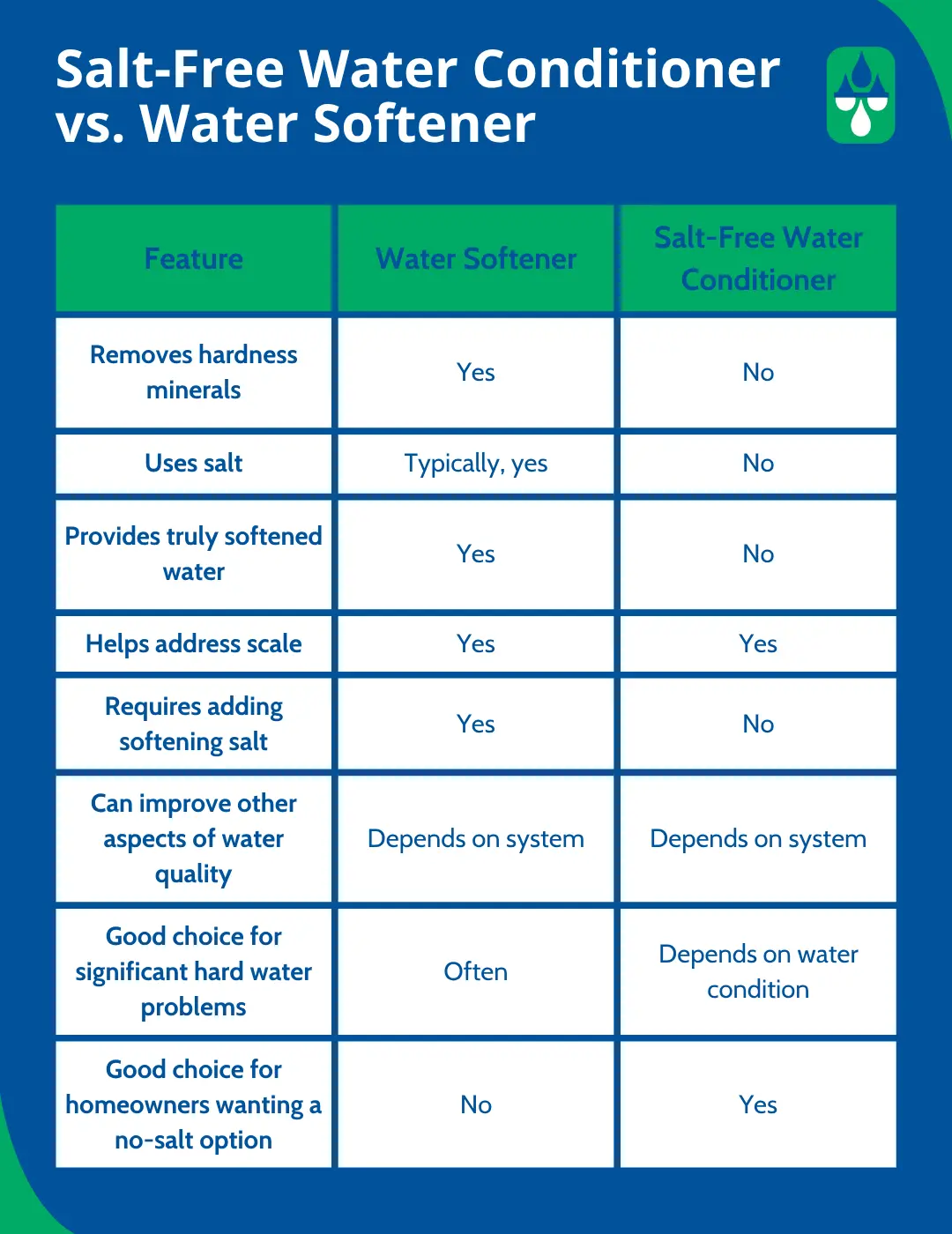
Traditional softeners also typically require salt or potassium and periodic regeneration. Salt-free systems avoid that conventional salt-based regeneration process.
There can also be differences in maintenance, water usage, installation requirements, and additional filtration capabilities depending on the equipment.
If you’d like a more detailed side-by-side comparison, read our related guide, “Salt-Free Water Conditioner vs. Water Softener: Which Is Right for Your Wine Country Home?”
What Doesn’t a Salt-Free Water Conditioner Do?
Knowing what a water treatment system doesn’t do can be just as useful as knowing its benefits.
Depending on the equipment, a salt-free conditioner generally should not be expected to:
- Remove calcium and magnesium like a traditional softener
- Produce technically “soft” water
- Eliminate all mineral spotting
- Automatically remove every contaminant
- Reduce TDS simply because it conditions hardness
- Replace reverse osmosis when high-purity drinking water is the objective
- Correct every possible well water problem
- Make microbiologically unsafe water safe to drink
- Different water problems require different technologies.
That’s why a professional water test can be more valuable than simply shopping for a product based on its name.
Understanding the “Salt-Free Water Softener” Terminology
If you’ve searched online, you’ve probably encountered the phrase “salt-free water softener.”
It’s easy to understand why: homeowners with hard water are frequently searching for a way to get the benefits of soft water without using salt.
Technically, however, “salt-free water conditioner” is the more accurate description.
If the system doesn’t remove hardness minerals, the water hasn’t been softened in the traditional sense. It has been conditioned to change how those minerals behave.
Understanding this terminology helps you compare systems based on what they actually do rather than assuming that every hard water treatment technology produces identical results.
How Do You Know Whether Salt-Free Conditioning Will Work for Your Home?
Start by understanding your water.
Two homes—even within the same Wine Country community—can have different water characteristics. Private well water and municipal water can also present very different treatment challenges.
Before selecting a salt-free conditioner, it’s useful to know:
- How hard your water is
- Whether you have municipal or well water
- If chlorine is present
- Whether iron or manganese is a concern
- Your water’s taste and odor characteristics
- Whether sediment is present
- What you’re hoping to accomplish with treatment
Then think about your priorities.
Are you primarily concerned about protecting your plumbing and appliances from scale? Do you want to avoid using salt? Is chlorine taste and odor bothering you? Or are you actually looking for the noticeably soft-water experience produced by a traditional softener?
The answers can point toward very different treatment solutions.
Salt-Free Water Conditioning for California’s Wine Country
Water quality can vary throughout Napa, Sonoma, Mendocino, Lake, and Solano Counties. Homeowners may be dealing with municipal water in one community and private well water just a short distance away.
That’s why Rayne of the Wine Country doesn’t take a one-size-fits-all approach to water treatment.

We offer a variety of residential solutions, including:
- No-salt water conditioners for scale protection and other whole-home water quality improvements without traditional softening salt
- Water softeners for homeowners who want calcium and magnesium hardness removed
- Chlorine removal systems for homes where chlorine is a primary concern
- Reverse osmosis drinking water systems for high-quality water for drinking and cooking
- Well water treatment designed around the particular challenges found in private water supplies
- Water testing to help identify the problems that need to be treated
The right equipment isn’t simply the system with the longest list of features. It’s the system designed to address what’s actually happening with your home’s water.
Find Out If a Salt-Free Water Conditioner Is Right for YOU
So, what is a salt-free water conditioner?
At its simplest, it’s a different approach to managing hard water minerals. Instead of removing calcium and magnesium, the system conditions those minerals to help protect your home against scale—all without requiring traditional water-softening salt.
For the right home, that combination of scale protection, convenient maintenance, and salt-free operation can make it an attractive water treatment solution.
But don’t choose a system based on the words “salt-free” alone.
Your water source, hardness level, other water quality concerns, and expectations all matter. The most effective way to choose a treatment system is to first determine what’s actually in your water.
Contact us today to schedule a FREE water test. Our local water treatment professionals can evaluate your home’s water and help determine which system or customized combination is right for you.