
You turn on the kitchen faucet, fill a glass of water, and immediately notice an unpleasant smell. Or perhaps you’ve stepped into a hot shower only to discover that the water smells like rotten eggs. Either way, it’s enough to make you question the quality of your home’s water supply.
If your water smells like rotten eggs, the most common explanation is hydrogen sulfide gas or sulfur-related bacterial activity. These issues can occur naturally in groundwater, develop inside household plumbing, or originate in your water heater.
For homeowners throughout Sonoma, Napa, Mendocino, Lake, and Solano Counties, understanding what’s causing the odor is the first step toward finding an effective solution.
The good news? Many sulfur-related water problems can be treated. However, not every rotten egg odor has the same cause, and not every water filtration system will solve the problem. That’s why identifying the source and having your water professionally tested are so important.
Let’s explore what might be happening with your water and what you can do about it.
What Causes Water to Smell Like Rotten Eggs?
The rotten egg smell in water is most commonly caused by hydrogen sulfide gas, which may occur naturally in groundwater or be produced by sulfur bacteria. In some homes, the odor develops inside the water heater rather than coming directly from the water supply.
Hydrogen sulfide is a colorless gas with a distinctive sulfur-like odor. Even relatively small amounts can make household water unpleasant to use.
There are several possible sources.
1. Naturally Occurring Hydrogen Sulfide in Groundwater
Hydrogen sulfide can form naturally when organic matter breaks down or when chemical reactions occur between water, minerals, and surrounding geological materials.
As groundwater travels through soil and rock formations, it may pick up dissolved gases and minerals. When that water reaches your faucet, hydrogen sulfide can escape into the air, creating the familiar rotten egg smell.
This can be particularly relevant for homeowners who rely on private wells.
Although groundwater conditions vary considerably throughout California’s Wine Country, properties with private wells may encounter water quality concerns involving sulfur, iron, manganese, hardness, or other naturally occurring substances.
Common signs of hydrogen sulfide in well water include:
- A rotten egg smell from both hot and cold faucets
- Odors that become noticeable when water is running
- Black staining on plumbing fixtures or silverware
- Corrosion affecting certain plumbing components
- An unpleasant sulfur-like taste
However, these symptoms alone cannot confirm the source or concentration of hydrogen sulfide. Professional water testing is needed to determine what’s actually present in your water.
2. Sulfur Bacteria in Wells and Plumbing
Another possible explanation is the presence of sulfur bacteria.
These naturally occurring microorganisms can live in groundwater, wells, plumbing systems, and water treatment equipment. Certain bacteria produce hydrogen sulfide as part of their biological activity.
Sulfur bacteria may also create a slimy buildup known as biofilm.
Over time, this buildup can contribute to problems such as:
- Persistent unpleasant odors
- Slime inside plumbing or treatment equipment
- Clogged filters and other water system components
- Conditions that support additional bacterial growth
Sulfur bacteria themselves are generally considered nuisance organisms rather than direct causes of illness. However, their presence does not establish that the water is safe to drink.
If your well water develops a new odor, appropriate testing for potentially harmful microorganisms is still important.
3. Your Water Heater May Be Causing the Smell
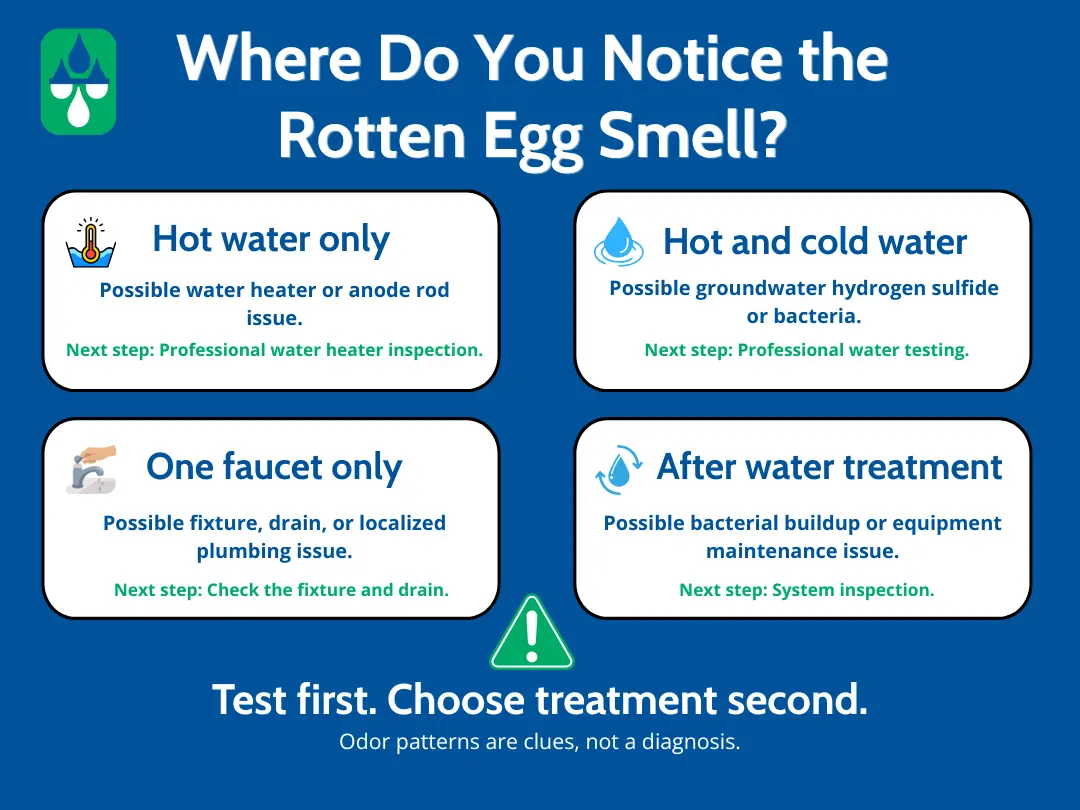
Does your hot water smell like rotten eggs, but your cold water smells normal?
If so, your water heater may be responsible.
Many traditional tank-style water heaters contain a metal component called an anode rod. This rod helps protect the tank from corrosion.
Under certain conditions, reactions involving the anode rod, sulfates in the water, and bacterial activity can produce hydrogen sulfide.
The warm environment inside the tank may also encourage sulfur bacteria to grow.
If the odor occurs only when using hot water, a plumber or qualified water system professional should inspect the water heater.
Possible solutions include servicing or disinfecting the tank or replacing the anode rod with a suitable alternative.
Important: Don’t simply remove the anode rod or raise the water heater temperature without professional guidance. Removing the rod can shorten the tank’s lifespan, while excessively hot water creates a serious scalding risk.
4. Problems Within Your Household Plumbing or Water Treatment Equipment
Sometimes the odor isn’t coming directly from the groundwater or the water heater.
Sulfur bacteria can develop in sections of household plumbing or within existing water treatment equipment.
For example, if the smell is present only at one faucet, the issue may be localized to that fixture, its drain, or nearby plumbing.
If the smell develops only after water passes through a particular treatment system, that equipment may need inspection or maintenance.
It’s also worth checking whether the smell is coming from the water itself or from the sink drain.
One simple way to investigate is to fill a clean glass with cold water, move away from the sink, and smell the water. If the odor disappears, the drain may be the source.
This distinction can help prevent unnecessary water treatment purchases.
Is Water That Smells Like Rotten Eggs Safe to Drink?
A rotten egg odor does not automatically mean your drinking water is unsafe. However, you should never assume that water is safe simply because hydrogen sulfide is a common cause of the smell.
Hydrogen sulfide at concentrations typically encountered in household water is often primarily an odor and aesthetic concern.
Nevertheless, there are several important considerations.
First, the presence of sulfur bacteria doesn’t rule out other microorganisms or contaminants.
Second, a sudden change in water odor may indicate a change in your well, plumbing system, or groundwater conditions.
Third, hydrogen sulfide gas can be hazardous when it accumulates at high concentrations in enclosed spaces.
For these reasons, homeowners with persistent or newly developing sulfur odors should arrange appropriate water testing.
If you suspect sewage contamination, experience a sudden strong odor accompanied by other water quality changes, or receive an unsafe test result, avoid using the water for drinking or cooking until you’ve received guidance from your local health department or qualified water professional.
How to Find Out Why Your Water Smells Like Rotten Eggs
Before investing in a water filtration system, it’s helpful to determine when and where the odor occurs.
The following observations can help narrow down the possibilities.
Why Professional Water Testing Matters
When your water smells like sulfur, it’s tempting to immediately shop for a filter that promises to eliminate the odor.
Unfortunately, this approach can lead to purchasing a system that doesn’t address the underlying problem.
For example:
- If the smell comes from your water heater, a whole-house filtration system may be unnecessary.
- If sulfur bacteria are growing inside your well, filtration alone may not resolve the biological source.
- If dissolved hydrogen sulfide is present in groundwater, a properly designed treatment system may be needed.
- If your water also contains iron, manganese, or other contaminants, the treatment system may need to address multiple water quality issues.
Professional water testing helps determine both the source of the problem and the most appropriate treatment approach.
Depending on your water source, symptoms, and existing equipment, a water quality evaluation may include testing for:
- Hydrogen sulfide
- Iron and manganese
- pH and acidity
- Water hardness
- Total dissolved solids (TDS)
- Sulfates
- Total coliform bacteria and E. coli
- Other contaminants associated with local groundwater conditions
Not every household needs every test. A knowledgeable water treatment professional can help identify which analyses are appropriate, while certified laboratory testing should be used for health-related contaminants.
The results provide a foundation for choosing a system based on actual water conditions rather than guesswork.
How Do You Get Rid of a Rotten Egg Smell in Water?
The best way to eliminate a rotten egg smell depends on what’s causing it.
There isn’t one universal solution that works for every household.
1. Specialized Filtration for Hydrogen Sulfide
When testing confirms that dissolved hydrogen sulfide is present in the water supply, specialized filtration may be an effective solution.
Certain filtration systems use oxidizing media to convert dissolved hydrogen sulfide into particles that can then be removed from the water.
Depending on the equipment, these systems may also address other water quality concerns, such as iron or manganese.
However, performance depends on factors such as hydrogen sulfide concentration, pH, water chemistry, flow rate, and the particular filtration media being used.
A system designed for one household’s well water may not be appropriate for another.
2. Activated Carbon Filtration
Activated carbon filtration may help reduce hydrogen sulfide odors when concentrations are relatively low.
Carbon works by adsorbing certain substances from water, but its capacity is limited.
At higher hydrogen sulfide concentrations, a basic carbon filter may become exhausted quickly or fail to provide adequate treatment.
That’s why an ordinary drinking water filter or refrigerator filter shouldn’t automatically be considered a solution to sulfur odors.
Professional testing can help determine whether carbon filtration is appropriate or whether a more specialized system is needed.
3. Aeration and Filtration
Aeration is another potential treatment method for hydrogen sulfide.
This process brings water into contact with air, allowing dissolved gases to escape.
Depending on the system design, aeration may be combined with additional filtration or other treatment processes.
Proper equipment design and ventilation are especially important because hydrogen sulfide gas must be managed safely.
4. Oxidation and Filtration Systems
For some water supplies, oxidation followed by filtration may be recommended.
These systems use treatment processes that convert dissolved hydrogen sulfide into a form that can be separated from the water.
Depending on the situation, treatment may involve controlled chemical oxidation, ozone, or specialized filtration media.
These systems require appropriate sizing, maintenance, and consideration of the overall water chemistry.
The right choice depends on professional testing and system evaluation.
5. Well Disinfection or Water Heater Service
If bacterial activity is responsible for the odor, the solution may involve disinfecting the well, plumbing system, or water heater.
However, disinfection and filtration address different aspects of the problem.
Disinfection targets microorganisms, while filtration is intended to remove specific substances from the water.
Some wells may require additional cleaning or corrective work if bacterial buildup is persistent.
A qualified well contractor or plumbing professional should evaluate these situations and determine whether disinfection, repairs, or other treatment is necessary.
Can a Water Softener Remove Rotten Egg Smell?
This is a common question, particularly among homeowners who already have a water softener.
A traditional water softener is not designed to remove hydrogen sulfide gas.
Water softeners primarily address hardness minerals, such as calcium and magnesium, through ion exchange.
Although some specialized treatment systems can address multiple water quality problems, a standard softener should not be relied upon to eliminate sulfur odors.
If your home has both hard water and hydrogen sulfide, you may need a combination of treatment technologies.
For example, one system might address sulfur and iron while another softens the water.
The correct equipment and treatment sequence depend on your water test results.
This is another reason why professional water analysis is so valuable. Rather than purchasing separate systems based on individual symptoms, you can develop a more complete treatment plan.
Why Well Water Testing Is Especially Important in California’s Wine Country
Many homeowners throughout Sonoma County, Napa County, Mendocino County, Lake County, and Solano County rely on private wells for household water.
Unlike municipal water supplies, private wells generally aren’t subject to the same routine public drinking water monitoring requirements.
That means well owners are responsible for arranging appropriate testing and maintaining their water systems.
Groundwater conditions can also vary significantly between neighboring properties.
Two homes in the same community may have very different water quality depending on well depth, geological formations, surrounding land use, and other factors.
How Often Should You Test Your Well Water?
The U.S. Environmental Protection Agency recommends testing private wells at least annually for total coliform bacteria, nitrates, total dissolved solids, and pH.
Additional testing is recommended when you notice changes in water quality, including unusual odors, tastes, or discoloration.
You should also consider testing after flooding, significant nearby land disturbances, or repairs to your well system.
For homeowners dealing with rotten egg odors, testing may need to include hydrogen sulfide and other sulfur-related water quality indicators.
Because some contaminants cannot be detected by smell, appearance, or taste, a broader assessment may also be appropriate.
The goal isn’t simply to make the water smell better. It’s to understand its quality and determine whether treatment is needed for other reasons.
Frequently Asked Questions About Water That Smells Like Rotten Eggs
Why does my well water suddenly smell like rotten eggs?
A sudden rotten egg smell may indicate changing groundwater conditions, sulfur bacterial activity, or a problem within your well or plumbing system. If the odor is new, arrange professional testing to determine whether hydrogen sulfide or other contaminants are present.
Why does only my hot water smell like sulfur?
If the smell occurs only when using hot water, the water heater is a likely source. Reactions involving the anode rod or bacterial activity inside the tank may produce hydrogen sulfide. A qualified plumber can inspect the heater and recommend corrective action.
Will a water filter remove the rotten egg smell?
Some water filtration systems can reduce hydrogen sulfide, but effectiveness depends on the type of filter and the concentration of the gas. Activated carbon may work for relatively low concentrations, while higher levels may require specialized filtration or oxidation systems.
Can I get rid of sulfur smell in well water permanently?
Long-term odor control is often possible, but the results depend on the underlying cause. Properly designed treatment systems can continuously reduce hydrogen sulfide, while bacterial problems may require well maintenance or disinfection. Some systems need ongoing maintenance to remain effective.
Does boiling water remove the sulfur smell?
Heating or boiling water may release some dissolved hydrogen sulfide, but it isn’t a reliable or recommended whole-house treatment method. It can also release the gas into indoor air and does not address the underlying source. If contamination is suspected, follow testing results and public health guidance rather than relying on boiling.
Is hydrogen sulfide the same as sulfate in water?
No. Hydrogen sulfide is a gas responsible for the characteristic rotten egg odor. Sulfate is a dissolved mineral compound that generally doesn’t have the same smell. Under certain conditions, sulfate-reducing bacteria can convert sulfate into hydrogen sulfide.
Can rotten egg-smelling water damage my plumbing?
Hydrogen sulfide can contribute to corrosion of certain plumbing materials and metal components. Sulfur-related bacterial buildup may also affect plumbing and treatment equipment. Identifying and addressing the problem can help protect your household water system.
Should I test my water before buying a sulfur filter?
Yes. Professional water testing is one of the most important steps before selecting a sulfur filtration system. The correct treatment depends on the hydrogen sulfide concentration, overall water chemistry, and whether the odor comes from the well, water heater, or plumbing system.
Get to the Source of Your Water Problems With Rayne of the Wine Country
If your water smells like rotten eggs, you shouldn’t have to live with the unpleasant odor—or spend money guessing which filter might solve it.
At Rayne of the Wine Country, we understand that every home’s water is different.
Our locally experienced water treatment professionals help homeowners throughout Sonoma, Napa, Mendocino, Lake, and Solano Counties address a variety of water quality concerns, including sulfur odors, iron, hardness, acidity, and other well water problems.
We offer specialized well water treatment and filtration solutions designed to address specific water quality needs.
Our approach starts with understanding the problem—not simply recommending a product.
By evaluating your water source, discussing your concerns, and identifying the appropriate testing, we can help determine which treatment options make sense for your home.
Whether your water requires specialized sulfur filtration, treatment for multiple well water concerns, or a different solution entirely, we’re here to help you make an informed decision.
Tired of water that smells like rotten eggs?
Contact us today to discuss your water quality concerns and learn how professional water testing can help you take the next step toward cleaner, better-smelling water.